
Geometric Brownian Motion (GBM): The Engine of Wall Street
There is a fundamental flaw in using standard Brownian Motion to model the stock market: a stock's price cannot be negative, and absolute dollar movements don't scale properly with asset size.
To fix this, quants use Geometric Brownian Motion (GBM). GBM modifies the randomness so that it applies to the percentage return of the asset, rather than the absolute dollar amount. Furthermore, it introduces a structural bias to the randomness.
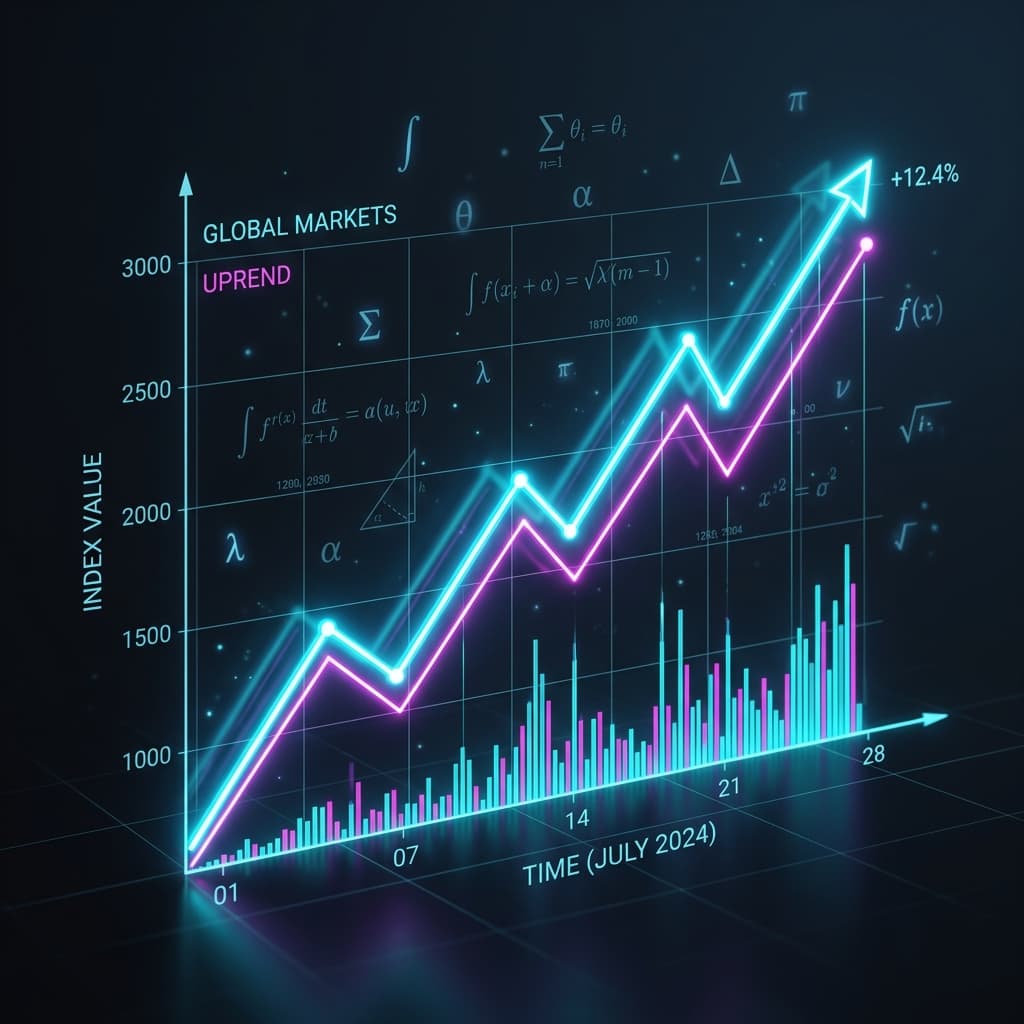
Imagine throwing a feather into the wind. The feather will jitter and dart around randomly due to air turbulence (this is the Volatility, or σ). However, if you are throwing the feather while standing on a rising elevator, the feather will still jitter randomly, but its overall trajectory will slowly drift upwards (this is the Drift, or μ).
This single equation is the philosophical core of modern financial engineering. It acknowledges that while the precise path of the market is unknowable, the geometry of its randomness can be perfectly modeled, measured, and exploited by trading engines.